The Single Shaft Shredder is a versatile powerhouse, but its efficiency depends entirely on how well its mechanical features match your specific material flow. To maximize your ROI and output, consider these critical engineering factors:
1. Rotor Knife Design and Maintenance
The efficiency of a shredder is only as good as its cutting edge.
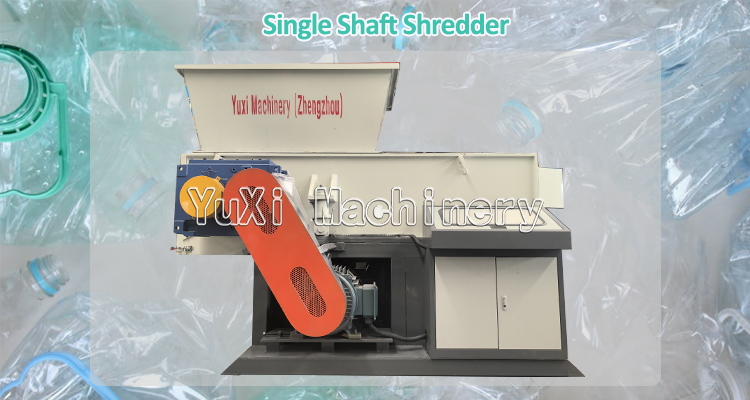
Four-Edge Rotation: Look for a machine where the rotor knives can be rotated and used on all four edges before needing a full replacement. This significantly lowers your long-term maintenance costs and downtime.
Shearing Precision: The shredding action occurs through mutual shearing between movable and fixed blades. Ensure the blade gap is adjustable to maintain high-quality cuts even as the blades wear.
2. Hydraulic Pusher System Efficiency
A single-shaft shredder relies on a pusher to bring material to the rotor.
Horizontal Pusher System: A large-capacity hopper combined with a horizontal pusher driven by a hydraulic cylinder ensures a consistent feed, which is essential for high output.
Optional Pusher Rams: For specialized operations involving hollow or gigantic materials, verify if an “Extra Pusher Ram” is available to prevent material bridging and ensure the rotor stays engaged.
3. Intelligent PLC Control and Protection
Modern recycling is about smart protection, not just raw power.
Auto-Reverse Logic: Your shredder must have a PLC system that automatically re-orients rotor direction if the motor overloads or a material jam occurs. This prevents shaft damage and motor burnout.
Safety Compliance: Ensure the machine adheres to mechanical protection and safety standards, such as the EU CE certification, to protect your operators and your facility.
4. Output Control and Sizing
Unlike rough shredders, the single-shaft unit provides a controlled particle size.
Screen Discharge System: The particle size is strictly determined by the aperture of the screen.
Adjustable Output: For most industrial applications, look for a screen system that can control output sizes between 20-40mm to meet downstream processing requirements.
5. Material Versatility
Before purchasing, confirm the shredder’s application range matches your waste stream:
Plastics: Capable of handling film, PET bottles, and dense plastic lumps.
Industrial Waste: Efficiently shreds sponge, textiles, leather, and wood.
Metals & Paper: Suitable for aluminum cans, shavings, documents, and cardboard.
Engineering Checklist for Buyers:
Output Requirements: Can the screen system meet your specific 20-40mm size needs?
Control System: Does the PLC include automatic jam clearing and rotor re-orientation?
Maintenance: Are the rotor knives four-edge rotatable to maximize tool life?
Summary
Product: Single Shaft Shredder Applications: Plastic lumps, PET bottles, textiles, aluminum shavings, and cardboard. Key Technical Terms: PLC automatic control, horizontal pusher system, rotor knives, screen discharge, EU CE certification.
Is your current shredding process failing to achieve a uniform particle size? Choosing the right Single Shaft Shredder will streamline your recycling line and reduce manual intervention. For a 30-minute technical reply or a custom 24H design proposal, contact the Yuxi engineering team.
Would you like me to help you determine which rotor speed and blade configuration is best for your specific material density?

Share:
About author
Marie
Nullam varius luctus pharetra ultrices volpat facilisis donec tortor, nibhkisys
habitant curabitur at nunc nisl magna ac rhoncus vehicula sociis tortor nist
hendrerit molestie integer.